
Still, Serraj’s government still has plenty of work to do to turn this rhetoric into reality. It depends on the dubious goodwill of various militias, tribal groups, and strongmen that emerged out of the 2011 uprising against Colonel Muammar Gaddafi, backed by a number of Western and Arab powers. In the six years since Gaddafi’s overthrow, Libya has fallen into chaos as rival groups have scrambled for power — and control of the country’s oilfields. But this interregnum is far from over: a return to democratic rule looks distant in 2017, in spite of the efforts of both Serraj and the international community.
The fall of Libya’s long-standing dictator scattered the multitude of ethnic and tribal groups that his iron fist had held together: groups which have radically different ideas of what Libya ought to be. After 42 years of Gaddafi’s highly charismatic and personal rule, state institutions had been eroded to the point where they were weak or non-existent, and infighting soon began within rebel ranks. Troubled by a particularly violent offshoot of the Islamic State (ISIS), as well as waves of refugees setting off across the Mediterranean from the Libyan coast, Western countries and the UN are once again trying to bring unity to its fractious political landscape – this time under President Serraj’s Government of National Accord (GNA).
Political success in Libya has always rested on robust coalition building, and the GNA had hoped to do just this, agreeing on a common plan of action with the commanders of the various militias operating across the country — presently thought to number nearly 2,000. As with other attempts to heal Libya’s post-Gaddafi divides, however, progress quickly became bogged down, with rival state institutions paralyzed by infighting and functionaries squaring off against one another in a tussle for coveted senior appointments. In October, Serraj’s administration was nearly toppled by a coup in Tripoli led by Khalifa al-Ghawil, a former prime minister of the previous National Salvation government, which Serraj’s administration had itself forced out in March.
The October coup attempt was eventually put down by pro-GNA militiamen, but a gulf endures between the GNA in Tripoli and the rival Tobruk-based parliament, the House of Representatives, that refuses to recognise the authority of either the GNA or al-Ghawil’s administration. A civil war between those militias aligning themselves with the Islamist-dominated National Salvation government, and those backing the secular House of Representatives and GNA continues to take its toll. The political vacuum and the civil war have allowed Libya to act as an ideal breeding ground for ISIS militants, who, despite the best efforts of the international community, retain a strong foothold in the region.
Haftar’s rise has strong parallels with events in neighboring Egypt, which also saw the overthrow of its longtime dictator Hosni Moubarak at the height of the Arab Spring, followed by a failed attempt to pivot towards democracy, and finally, the slightly-modified return old regime, albeit under a new strongman.
Libya’s lengthy dramatis personae of rival actors can come together in a coalition when it suits their interests, as shown by the recent and heavy wounds inflicted on ISIS in the country. But fresh plans to revive the country’s dormant oil sector worries observers, who believe that this may give rise to new struggles. Oil represents 98% of the government’s revenue, and Libya needs to pump a minimum of 800,000 barrels of oil a day in order to be able to pay public sector salaries, invest in much-needed infrastructure, and shore up its collapsing economy. But despite the country’s reliance on oil, every attempt made so far to build a coalition capable of restarting the pumps has failed.
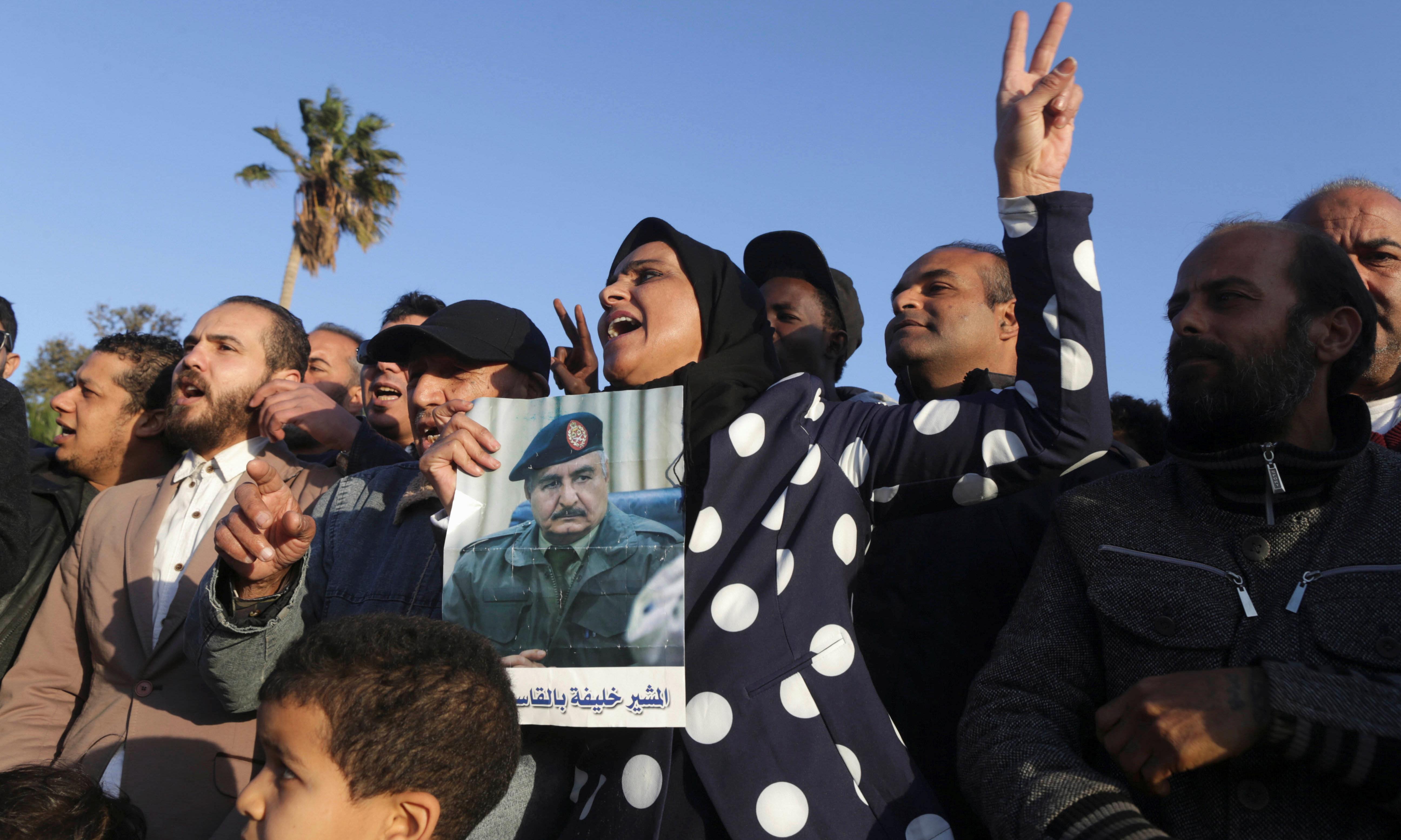
At issue is the future role of General Khalifa Haftar, the leader of the Libyan National Army (LNA), which lends the House of Representatives the support it needs to continue governing. General Haftar was one of the army officers who helped bring Gaddafi to power in 1969, but later fell out with the colonel. Nonetheless, his past association with Gaddafi, connections with the CIA, and hardline attitude towards political Islamists have made him a controversial figure. The LNA has strengthened in recent months, sweeping up oil facilities in Libya’s energy heartlands. It stands to benefit not only from the revenue that these facilities bring in, but the increased credibility among other militia that holding them entails. Haftar’s steady accumulation of power and his courting of Russia, United Arab Emirates and Egypt are leading many Libyans to view him as a strongman-in-waiting.
Haftar’s rise has strong parallels with events in neighboring Egypt, which also saw the overthrow of its longtime dictator Hosni Moubarak at the height of the Arab Spring, followed by a failed attempt to pivot towards democracy, and finally, the slightly-modified return old regime, albeit under a new strongman. Both Haftar and his Egyptian counterpart, President Abdel Fattah el-Sisi, have justified their actions by arguing that they are fighting terror, and both attempted to seize power via a coup. Few Libyans really want to be ruled by a Gaddafi-era autocrat, but after a revolution and nearly five years of civil war, many are sick of the endless political squabbling that is preventing their country’s recovery.
Popular confidence in President Fayez Serraj’s GNA is also low – the ousting of a number of elected mayors and other officials in the east by Haftar and his allies has shone a light on the limited influence that the GNA wields there, and with much of Libya’s remaining oil wealth flowing into the coffers of Haftar’s eastern government, he is looking stronger than he was twelve months ago. Haftar remains mistrusted by many western Libyan militias, who have long resisted giving him a role in any future government of national unity. But given his penchant for political leaders with military backgrounds and the growing clout of the east, which is, according to his rivals, already under de facto military rule, the future of Libya may belong to Haftar and not to Serraj.
