
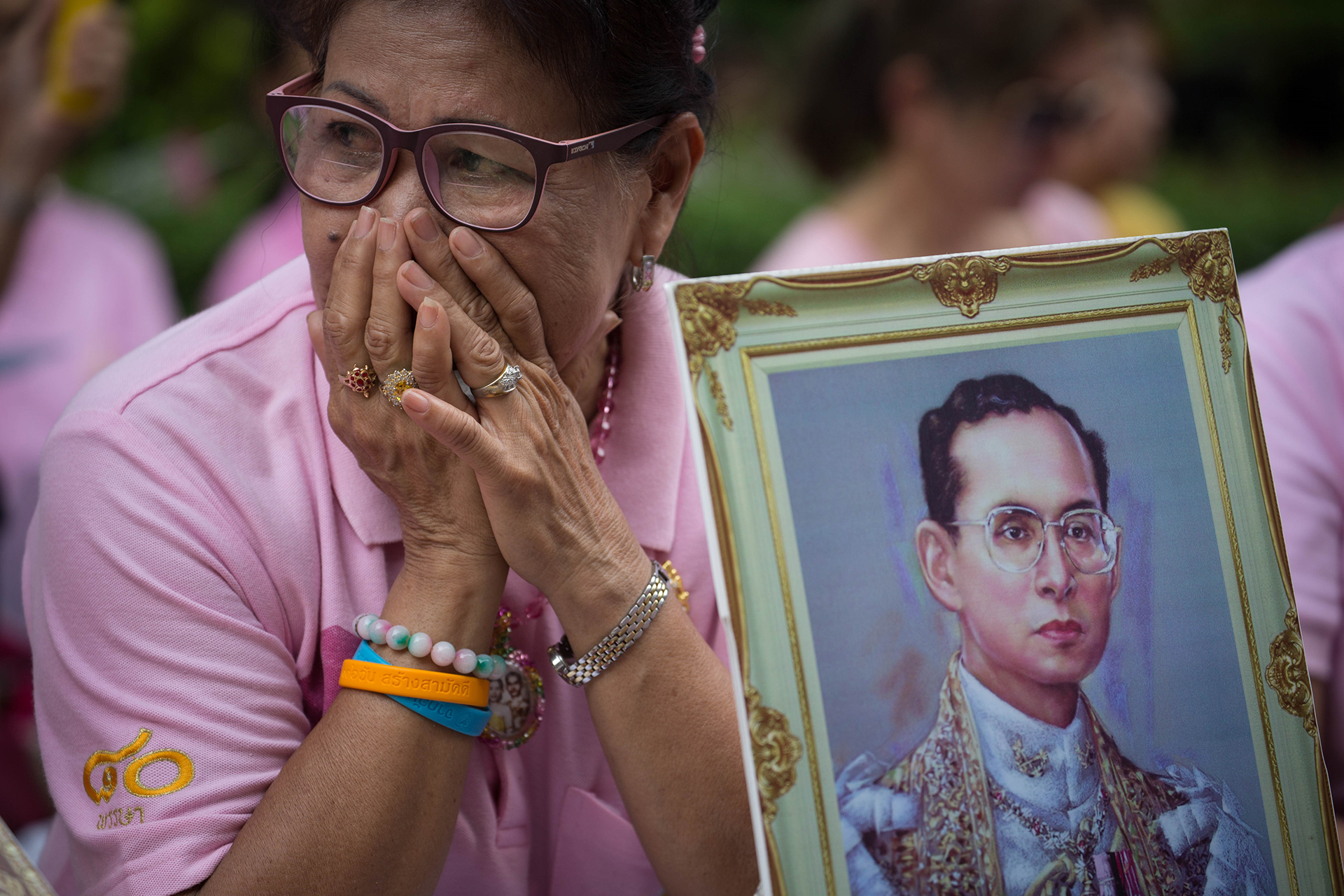
King Bhumibol occupied a unique position in Thailand’s domestic politics, neither directly involved but never completely disengaged. The king was indeed known to mediate disputes, publicly reprimand political leaders, and is believed to have tacitly endorsed a number of coups that shook Thailand throughout his reign. Revered by the Thai public, the State declared a prolonged period of mourning following the news of his death.
The end of this steady presence has led some to speculate whether King Bhumibol’s death will precipitate domestic unrest in Thailand. Following the latest military coup in June 2014, Thailand has been undergoing a period of transition, including attempts at implementing a new draft constitution. This upheaval unsettled Thailand’s economy. In the immediate aftermath of the 2014 coup, the Bank of Thailand’s Private Investment Index had contracted by 2.7% from the previous year, and the number of overseas visitors was down 24.4% from June 2013 — anathema for an economy as heavily reliant on tourism as Thailand.
As Thailand’s generals sought to stabilize the reeling country, these figures began to show improvement. Tourism had increased by 20% in the year following the coup, and Thailand’s economic growth was at 3.2% in the first quarter of 2016. The increase in GDP over this period is indicative that confidence in Thailand’s domestic politics is slowly being restored, but the country still lags behind others in the region.
The death of King Bhumibol has the potential to significantly disrupt this growth. Crown Prince Maha Vajiralongkorn asked for his coronation to be delayed in order to allow an appropriate (and lengthy) period of mourning. This generated rumors regarding the heir’s appetite for the throne, which has long been in doubt. Spending much of his time residing in Germany, the crown prince is seen as enjoying the extravagant lifestyle that comes with being a member of a royal family without the responsibility. Thus far he has shown little interest in Thailand’s domestic politics or his father’s charitable causes. In an effort to avoid domestic instability, Thai officials have tried to play down concerns regarding the royal succession. They have been aided by Thailand’s strict lese-majeste laws, designed to shield the Thai royal family from insult, and enforced even over Facebook. Bangkok has used these laws to prevent Thai nationals from openly criticizing the crown prince or questioning his suitability for the throne.
Spending much of his time residing in Germany, the crown prince is seen as enjoying the extravagant lifestyle that comes with being a member of a royal family without the responsibility.
Thai officials assured a worried public that the crown prince would indeed take the throne following the requisite period of mourning, which had a positive impact on the country’s economic markets in the wake of the king’s death. While the Thai stock exchange lost 6.5% following the announcement that the king’s health was declining, stocks jumped to a five-year high, and the Thai baht strengthened by 0.9% when it became clear that the king’s death would not threaten the country’s stability. Fluctuations in the market were indicative of investor concern around the economic and political trajectory, and pressure on both the Thai stock market and the baht shrouded Thailand’s already fragile economic outlook in uncertainty.
It came as a relief to many when the Thai military junta announced that it was making preparations for the crown prince’s coronation. On December 1, following an invitation from the Thai parliament, the crown prince became King Maha Vajiralongkorn, also known as Rama X. It is hoped that a smooth transfer of power will help to boost investors’ confidence in Thailand. In the wake of the Thailand’s royal succession, the military announced plans to revitalize Thailand’s weak economy by investing in infrastructure projects worth $25.2 billion over 2017, covering railways, airports and roads. So far in the first quarter of 2017, finance ministry officials are bullish.
Given the scope of this project, maintaining stability is the top priority for Thailand’s military officials this year. Hopes will be high that the new king can project the same moderating and stabilizing influence as his father. Considering the reputation that precedes him, this won’t be without its difficulties. Questions remain over the extent of Vajiralongkorn’s relationship with the ousted prime minister Thaksin Shinawatra, with whom he is believed to have had business dealings. It is unclear whether the new king will attempt to engage with Shinawatra in the future, and how the military might respond to this. He also has a reputation for ruthlessness, having stripped his second wife and their three sons of their titles, and forced them to live in exile. There can be little doubt that Thailand’s military generals will be keeping a watchful eye on their new king. Hopefully, this will be enough to dispel any doubt over Thailand’s future.
